
How AI Voice Receptionists Capture After-Hours Leads: Inbound Call Handling, Qualification, and Instant Booking Architecture
By Farkhan Shah, AI Operations Lead | Everything AI, LLC | Estimated Read: 10 min | Category: Customer Experience & Voice Systems
An unanswered inbound call is a lost conversation before it is a lost customer. This guide breaks down the architecture behind an AI voice receptionist — telephony and voice API integration, conversational qualification, missed-call text-back, live CRM calendar injection, telephony compliance, and the operating cost comparison against traditional answering services — so real estate and service businesses can evaluate the systems that capture after-hours intent.
Near-instantaneous answer — the single largest controllable factor in keeping a high-intent caller on the line.
Nights, weekends, and overflow handled without overtime, voicemail, or third-party ring delays.
Every call transcribed, summarized, and synced to the CRM record automatically — no manual agent notes.
Explicit opt-in, quiet-hours enforcement, and audit trails are non-negotiable for any SMS-driven call-back workflow.
Traditional Call Center / Answering Service vs. Everything AI Voice Receptionist Engine
An objective operating comparison of a traditional answering service or call center against a connected AI voice receptionist engine. Figures are illustrative ranges, not guaranteed outcomes.
| Operating Capability | Traditional Call Center / Answering Service | Everything AI Voice Receptionist Engine |
|---|---|---|
| 24/7 Response Latency | 30 to 120 Seconds (Ring delay / hold time) | Instant (< 2 Seconds) |
| Concurrent Call Capacity | Limited by available human agents | Unlimited parallel inbound streams |
| CRM Data Logging | Manual summary typed by agent (High error rate) | 100% Automated call transcript & field sync |
| Monthly Operating Overhead | $1,500 - $3,500/mo (Per-minute human fees) | Fixed automated infrastructure tier |
Inbound AI Voice Telephony & Booking Architecture
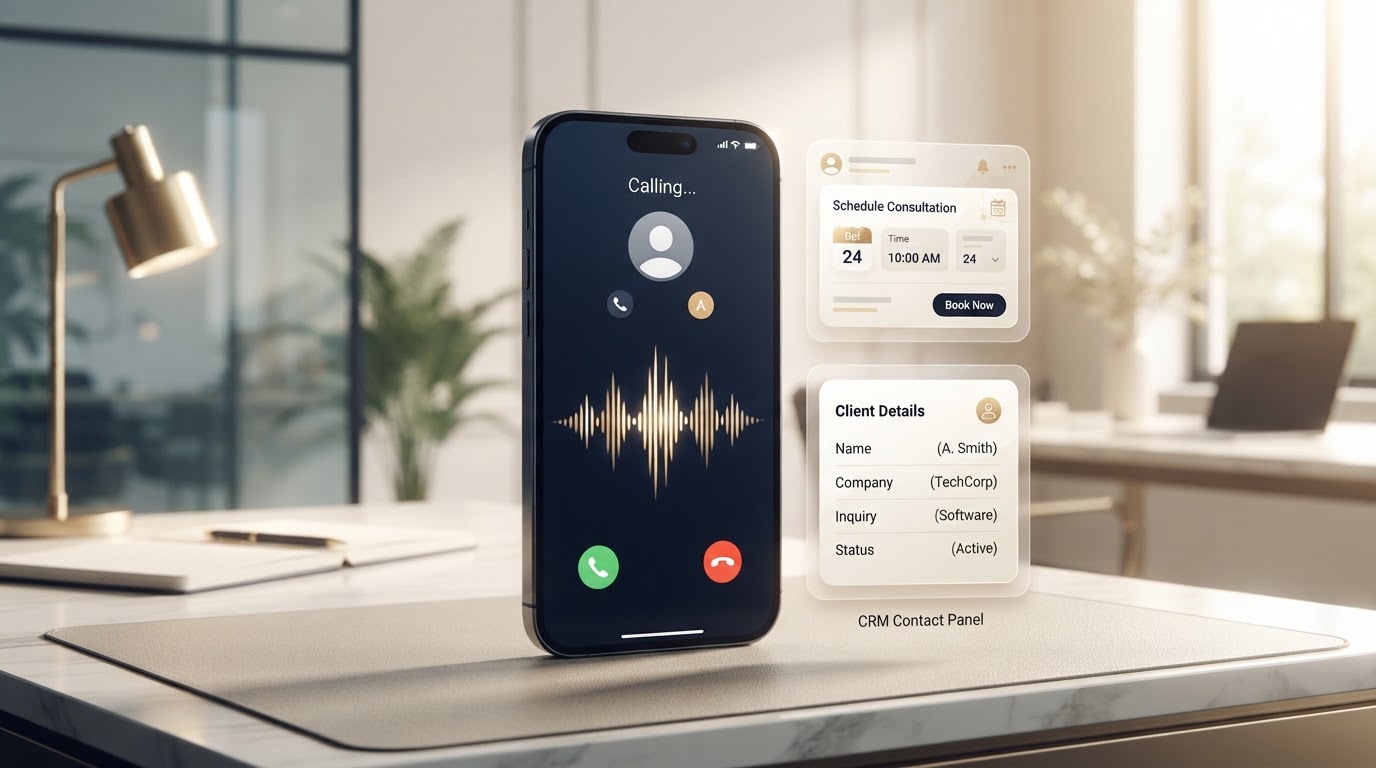
How an incoming after-hours call transitions to a confirmed CRM appointment and instant notification without human staff intervention.
Inbound Call Handling
The AI receptionist answers with a custom brand greeting in under two rings, recognizes caller ID, and pulls historical contact context where available.
Conversational Qualification
The agent holds a natural-language conversation — answering service, pricing, and area questions while capturing intent, property details, and timeline against documented criteria.
Live Calendar Scheduling
The agent reads real-time availability and confirms a consultation, walkthrough, or inspection slot, locking the appointment into both calendars on the call.
CRM Logging & SMS Confirmation
The call is transcribed and summarized to the CRM record, and a calendar invite plus SMS confirmation is dispatched instantly — with a missed-call text-back for any unanswered ring.
01.The After-Hours Response Gap
In high-intent service categories — real estate acquisition, property management, leasing, and home services — the inbound phone call is often the single highest-intent channel a business has. A caller who picks up the phone has already self-selected: they have a need, they have chosen a provider, and they are ready to talk. The question is whether someone answers.
The after-hours gap is the operational reality that most of these calls arrive when no one is sitting at the desk. Evenings, weekends, lunch hours, and overflow periods during peak marketing all produce calls that ring to voicemail or to a third-party service that cannot speak to the specifics of the business. A caller who reaches voicemail rarely leaves a message; the common behavior is to hang up and call the next result.
This is not a staffing problem that more headcount solves cleanly. A human answering service introduces its own latency — ring delay, hold time, message-taking, and call-back loops — and rarely has the context to qualify the call or book an appointment in the moment. The result is that the highest-intent leads are the ones most likely to leak out of the funnel at the point of contact.
A voice receptionist engine addresses the gap at the architectural level. The call is answered in under two rings, the conversation is held in natural language, the caller is qualified against the business's own criteria, and the appointment is booked directly into the calendar — all before any human is involved. The human is reserved for the conversations that require judgment, rapport, and negotiation, not for answering the phone.
Treat the inbound call as infrastructure, not headcount. The goal is not to replace the person who answers — it is to ensure that every high-intent caller reaches a competent, qualifying conversation within seconds, day or night.
Walk the after-hours call from ring to booked appointment
Click each stage to see the automated action the voice receptionist engine performs — from the inbound ring to a CRM-injected appointment. Illustrative demonstration flow.
A high-intent caller dials the business line after hours. The telephony layer answers in under two rings — no voicemail, no hold music — and the AI receptionist greets the caller with the brand voice and pulls any existing contact context.
Walk the after-hours call from inbound ring to CRM-injected appointment.
02.Telephony & Voice API Architecture
A voice receptionist engine is not a single product. It is a set of telephony, speech, and integration components that pass information between each other with low latency and a clear handoff at every stage. Understanding the stack is the difference between buying an answering service and deploying a system.
- Telephony trunking: a SIP or cloud telephony layer that receives the inbound call, manages the audio stream, and can port or forward an existing business number so callers dial the line they already know.
- Speech-to-text and text-to-speech: streaming recognition that transcribes the caller in real time and a neural voice model that responds with natural pacing, inflection, and sub-second conversational latency.
- Conversational reasoning: a language model that holds the dialogue, follows a qualification script, answers from a business knowledge base, and decides when to book, capture, or escalate.
- Calendar and CRM webhooks: the connective tissue that reads real-time availability, writes the appointment to the calendar, logs the transcript and summary to the CRM record, and notifies the assigned team member — without manual data entry.
- Missed-call text-back: a rule that fires an SMS to any caller whose call cannot be completed, recovering the inquiry within seconds rather than letting it go to voicemail.
- Analytics and logging: answer latency, call duration, qualification outcome, booking rate, and full transcript audit trails, measured against the call log rather than guessed at month-end.
Conversational voice lives or dies on response latency. A model that takes two seconds to reply feels like a human on hold; one that takes six feels like a robot. The architecture is tuned to keep turn-taking latency under the threshold where callers notice the gap.
03.Conversational Qualification & Intake
The qualification conversation is where the voice engine earns its keep. The agent follows a structured script configured to the business — for a real estate investor, that means capturing property address, condition, timeline, and asking expectation; for a property manager, it means capturing unit interest, move-in window, and tenant criteria. The output is a qualified, tagged record, not a voicemail message.
The division of labor matters. The system handles the work that is repeatable and rule-based: answering service and pricing questions from a knowledge base, capturing intake data, scoring intent, and booking the appointment. The human handles the work that requires judgment: evaluating the deal, building rapport, and negotiating terms. The boundary is the same as in any acquisition operation — automation gets the conversation started faster and with better information; the person closes it.
What the agent should handle automatically is the narrow, repeatable set: scheduling, FAQs, intake scoring, and missed-call recovery. What requires immediate human escalation is anything the knowledge base cannot resolve safely — an emergency maintenance report, a high-value custom deal, a legal or fair-housing question, or a caller who explicitly asks for a person. The escalation is a warm transfer with a full context summary, not a cold handoff.
04.Human Answering vs. AI Voice Cost Comparison
The operating comparison between a traditional answering service and a voice receptionist engine is not a feature checklist — it is a structural difference in how the call is handled, logged, and paid for. The table above summarizes the operating capabilities side by side.
A traditional call center charges by the minute or by the call, scales its capacity by adding human agents, and logs the conversation as a manual summary typed after the fact. A voice receptionist engine answers in under two rings, handles unlimited concurrent calls on a fixed infrastructure tier, and logs a full transcript and structured fields to the CRM automatically. The cost model shifts from a variable per-minute labor expense to a predictable infrastructure cost — and the data quality shifts from error-prone human notes to a complete, auditable record.
The honest framing is that the engine is not free. AI usage, telephony, and messaging carry their own costs, and a complex deployment is quoted on its scope. But the structure of the cost — fixed, predictable, and tied to infrastructure rather than per-minute labor — is what makes the after-hours gap closeable at a scale a human service cannot match.
05.Telephony Compliance & TCPA Consent
Any voice system that follows up an inbound call with SMS or automated call-back operates inside a regulated boundary. Treating compliance as an afterthought is the fastest way to compromise a program that otherwise works.
- Explicit consent. Automated SMS follow-up must rest on documented opt-in. An inbound call alone is not blanket consent to an automated messaging sequence; the consent state is captured and tracked per contact.
- Quiet-hours enforcement. Automated SMS dispatched outside permitted hours is a compliance failure, not a feature. The system enforces time-of-day rules by the recipient's locale.
- Call recording disclosure. Where calls are recorded or transcribed, applicable one-party or two-party consent rules apply and must be reflected in the call flow.
- Audit trail. If you cannot show when consent was captured, what was sent, and to whom, you cannot defend the program. Every message and call is logged.
- Opt-out handling. A stop or opt-out reply is honored immediately and propagated to every active sequence.
- Human escalation for regulated topics. Fair-housing, legal, and financial questions are escalated to a qualified human rather than answered by the agent, so the system never renders regulated advice.
Consent capture, quiet-hours enforcement, recording disclosure, and audit logging belong in the call flow design — not in a policy document reviewed after a complaint. Build them in from the first webhook.
06.Implementation Roadmap
Deploying a voice receptionist engine is a staged configuration, not a plug-in. The roadmap moves from the operational gap to a live, measured system in a defined sequence.
Stage one — discover. We evaluate where calls are leaking today: after-hours volume, voicemail drop-off, overflow periods, and the qualification data your team actually needs from each call. The script and knowledge base are designed around your business, not a generic greeting.
Stage two — design. The telephony layer is configured — porting or forwarding your existing number — and the conversational script, qualification criteria, calendar integration, and CRM webhook mapping are defined. Compliance rules are written into the flow at this stage.
Stage three — deploy. The engine is launched, the call flow is tested against real scenarios, and the team is onboarded on the notifications, transcripts, and pipeline handoffs they will receive.
Stage four — optimize. We monitor answer latency, qualification outcome, booking rate, and escalation accuracy, and tune the script and routing against the call log. The system improves against the metrics that describe how it behaves, not against vanity numbers.
Everything AI builds this architecture for real estate investors, agents, property managers, and service businesses. If you are evaluating whether a voice receptionist engine fits your operation, the most useful next step is a Business Growth & Automation Assessment — it identifies where after-hours calls, voicemail drop-off, and slow call-back are leaking opportunities, without a sales pitch disguised as a proposal.
Request a complimentary Business Growth & Automation Assessment to identify your highest-leverage voice gaps — after-hours answer rate, voicemail drop-off, call-back latency — and the systems that close them.
What unanswered calls could be costing you
Illustrative only. Not every call becomes a customer — this shows the math behind recovered after-hours inquiries, not a guaranteed result.
Estimate the value of recovered after-hours inquiries.
Keep building the connected stack
These guides connect the systems behind your acquisition, communication, and conversion operations.
- InsightAutomated Follow-Up Workflows That ConvertWhat happens after the call ends and the lead enters the pipeline.Read Guide
- InsightConversion-Focused Websites for Real EstateHow web inquiries route straight into the AI voice queue.Read Guide
- InsightAI Lead Acquisition for Real Estate InvestorsWhere captured calls become scored acquisition opportunities.Read Guide
Common Questions About This Architecture
Can I keep my existing business phone number?
Yes. We port or forward your existing business number so callers dial the same line they already know, while the voice receptionist answers in under two rings and books after-hours appointments directly into your calendar.
Does the voice sound robotic?
No. The system uses neural voice models with natural pacing and inflection, tuned to keep conversational turn-taking latency under the threshold where callers notice a gap. The voice and greeting are configured to your brand.
Can the AI receptionist transfer calls to a live agent?
Yes. For urgent callers, complex negotiations, or regulated topics, the system warm-transfers the call to the right person with a full context summary attached — not a cold handoff.
How does the receptionist book appointments after hours?
The agent reads real-time calendar availability during the call and confirms a consultation, walkthrough, or inspection slot, locking the appointment into both calendars and dispatching an SMS and email confirmation instantly.
Can it integrate with my existing CRM?
Yes. The architecture uses webhook and API bridges to push the call transcript, qualification summary, and booking metadata directly into your CRM record. We evaluate your existing platform and configure the integration rather than forcing a migration.
What happens to a missed call?
A missed-call text-back rule fires an SMS within seconds to any caller whose call cannot be completed, offering a reply path or a booking link so the inquiry is recovered rather than lost to voicemail.
Is the SMS follow-up TCPA compliant?
Consent is captured explicitly, quiet-hours rules are enforced by recipient locale, every message is logged with an audit trail, and opt-out is honored immediately. Compliance is built into the call flow, not added after the fact.
Is this a telecommunications carrier or advisory service?
No. Everything AI provides technology, automation, and digital marketing infrastructure. We are not a licensed telecommunications carrier, legal, or mortgage entity. Regulated questions are escalated to qualified professionals.
Farkhan Shah
AI Operations Lead | Everything AI, LLC
Over 20 years of real estate portfolio operations, financial literacy instruction, and B2B tech sales architecture. Helping property managers, investors, and service businesses deploy intelligent digital infrastructure that converts cold traffic into verifiable revenue.
Stop bleeding qualified leads to slow response times.
Request a complimentary 30-second Business Growth & Automation Assessment to identify your highest-ROI opportunities.
Consumer Protection & Operations Notice: Everything AI provides technology, automation, and digital marketing infrastructure. We are not a licensed real estate brokerage, legal, or mortgage entity. All property solutions connect users with qualified, independent professionals.
Operations Notice: Everything AI provides technology, automation, and digital marketing infrastructure. Farkhan Shah serves as AI Operations Lead. We are not a licensed real-estate brokerage, mortgage, or legal entity.