
AI Lead Acquisition for Real Estate Investors & Wholesalers: Architecture, Workflows, and Implementation
By Farkhan Shah, AI Operations Lead | Everything AI, LLC | Estimated Read: 12 min | Category: Real Estate Operations
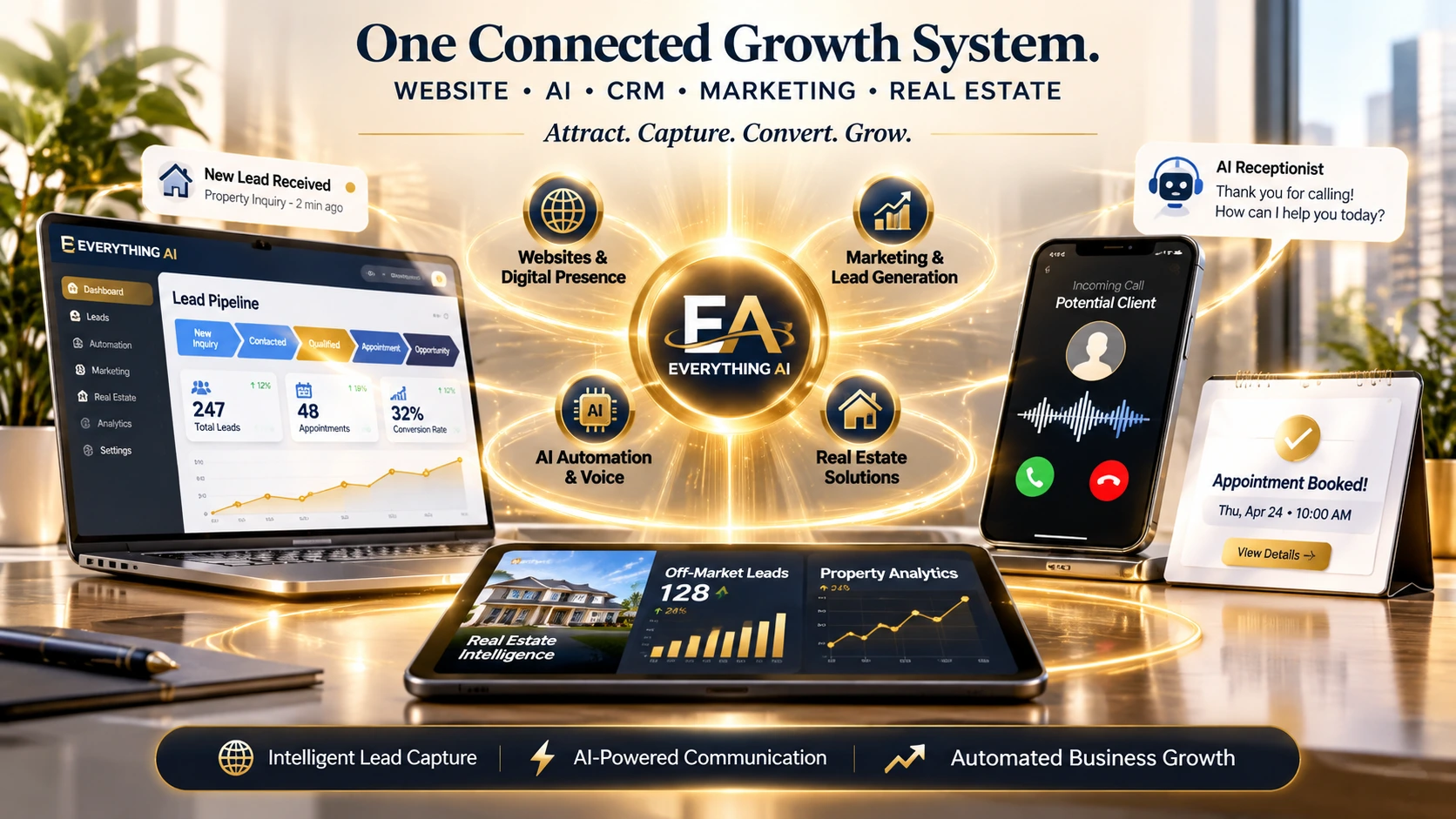
Off-market seller acquisition is an operational problem before it is a marketing problem. This guide breaks down the architecture behind a connected acquisition engine — landing-page capture, AI-assisted qualification, CRM pipeline routing, automated follow-up, and the metrics that actually measure performance — so investors and wholesalers can evaluate the systems that turn property traffic into verifiable pipeline.
Automated acknowledgement within the lead-decay window — the single largest controllable factor in seller retention.
The minimum connected workflow required to move a seller inquiry from form submission to assigned acquisition manager.
A documented Maximum Allowable Offer model (ARV × 70% − repairs − fee) removes emotion from the offer decision.
Explicit opt-in, quiet-hours rules, and audit trails are non-negotiable for any SMS-driven acquisition workflow.

Manual Wholesaling Process vs. Connected AI Acquisition Engine
An objective operating comparison of a manual wholesaling workflow against a connected AI acquisition engine. Figures are illustrative ranges, not guaranteed outcomes.
| Operating Metric | Manual Wholesaling Process | Connected AI Acquisition Engine |
|---|---|---|
| Inquiry Response Latency | 2 to 4 Hours (High Drop-off) | < 60 Seconds (Instant AI Voice/SMS) |
| Off-Market Qualification Rate | 18% Manual Phone Triage | 64% Automated Form & Call Scoring |
| Pipeline Stage Visibility | Manual Spreadsheet Updates | Real-time CRM Stage Automation |
| Lead Nurture Retention | 1 to 2 Follow-up Attempts | Multi-Touch Automated Nurture Sequences |
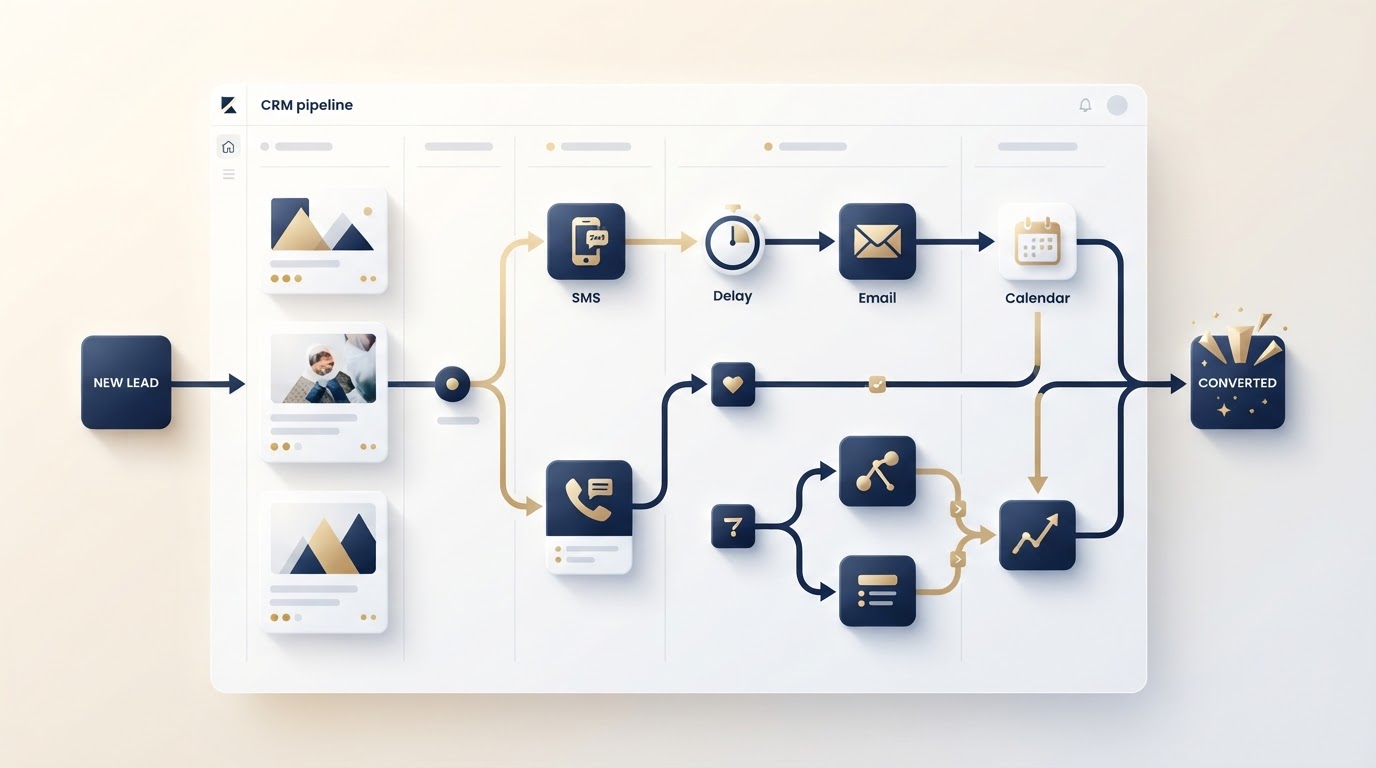
Automated Off-Market Seller Acquisition Architecture
How motivated seller inquiries move from initial ad or search discovery to contract review without manual bottlenecks.
Inquiry Capture
Seller discovers a landing page or map listing and submits property address, condition, timeline, and asking price through a conversion-focused intake form.
AI Qualification
A conversational intake agent validates condition, equity spread, title status, and urgency against documented acquisition criteria within the response window.
CRM Pipeline Routing
The lead is scored, tagged by deal strategy (wholesale, fix-and-flip, creative financing), and assigned to an acquisition manager for human review.
Automated Follow-Up
A multi-channel SMS and email sequence acknowledges the inquiry, schedules a walkthrough, and keeps the seller engaged until the manager takes over.
01.The Economics of Off-Market Seller Response Times
In off-market acquisition, the seller who submits an inquiry is almost always evaluating multiple options simultaneously. A homeowner considering a fast sale has searched, asked a neighbor, or filled out more than one form before yours. The operator that responds first, with a clear and professional pathway, is overwhelmingly the one that earns the conversation.
Lead decay is the operational reality behind this. The probability that a seller is still reachable and receptive declines sharply with elapsed time after the inquiry. The first minutes matter most: an acknowledgement within the response window signals competence and keeps the seller from moving to the next result. Hours later, the seller has often already committed elsewhere, cooled on the idea, or simply lost trust that anyone is listening.
This is not a marketing insight — it is a systems design constraint. If your acquisition operation cannot acknowledge an inquiry within the response window, you are not losing deals to better offers; you are losing them to faster infrastructure. The economics of off-market acquisition reward the operator who treats response time as an engineering problem rather than a staffing problem.
A connected acquisition engine addresses this directly. The acknowledgement is automated and immediate; the qualification begins before a human is involved; and the seller is kept warm with a documented sequence until an acquisition manager can take the conversation over. The human is reserved for the work that actually requires judgment — evaluating the deal, building rapport, and negotiating terms.
Treat response time as infrastructure, not headcount. The goal of automation is not to remove the acquisition manager — it is to ensure the manager only speaks with sellers who are still reachable, pre-qualified, and ready to talk.
Test the lead intake logic for an off-market seller
Adjust the inputs to see how a connected acquisition engine computes a Maximum Allowable Offer (MAO) benchmark and walks the inquiry through triage. All figures are illustrative math, not an appraisal, offer, or investment recommendation.
Off-Market Form Submission
Seller submits property address, condition, timeline, and asking price on the intake page.
Test lead intake logic: compute a Maximum Allowable Offer (MAO) benchmark and walk the inquiry through triage.
02.The Required Technical Stack
A connected acquisition engine is not a single product. It is a set of components that pass information between each other with as little friction as possible. Understanding the stack is the difference between buying a tool and building a system.
- Conversion-focused landing pages: forms engineered to capture the minimum information needed to qualify a seller — address, condition, timeline, and asking expectation — without friction that suppresses submission.
- AI voice and conversational intake: a layer that can answer inbound calls, hold a structured qualification conversation, and capture the same data a form would, for sellers who prefer to call.
- CRM pipelines: a structured set of deal stages (New Inquiry → Contacted → Qualified → Under Review → Offer → Contract) that every lead enters, so nothing is tracked in a spreadsheet or a memory.
- Webhook and API bridges: the connective tissue that moves a qualified lead from the intake layer into the CRM, triggers the follow-up sequence, and notifies the assigned manager — without manual data entry.
- Automated communication: SMS and email sequences that acknowledge, qualify, nurture, and confirm, with explicit opt-out handling and quiet-hours compliance.
- Analytics and reporting: response latency, lead-to-appointment rate, and cost per acquired contract, measured against the pipeline rather than guessed at month-end.
03.Step-by-Step Acquisition Workflow Architecture
The workflow is the contract between the components. Each stage has a defined input, a defined output, and a defined handoff. When any stage fails to produce its output, the failure is observable rather than silent.
Stage one — capture. A seller lands on a conversion-focused page and submits property details. The form is short by design; every additional field trades completion rate for information. The submission creates a lead record with a timestamp, a source, and the raw intake data.
Stage two — qualification. The intake layer evaluates the lead against documented acquisition criteria: motivation, timeline, equity indicators, and condition. The output is a qualification score and a deal-strategy tag. This stage is where automation earns its keep — it converts a raw submission into a structured, scored record without human effort.
Stage three — routing. The qualified lead enters the CRM at the correct deal stage and is assigned to an acquisition manager. Routing rules determine assignment: by geography, by deal strategy, or by manager capacity. The manager receives a notification with the qualification summary and a direct path to act.
Stage four — nurture. Until the manager takes the conversation over, an automated sequence keeps the seller engaged: an immediate acknowledgement, a qualification follow-up, and a scheduling prompt. The sequence is designed to hand off cleanly — when the manager makes contact, the seller is already warmed and informed.
Every stage must produce an observable output. If qualification produces no score, routing cannot assign. If routing assigns no manager, nurture runs indefinitely. The system is only as reliable as its weakest handoff.
04.Automated Lead Scoring vs. Human Acquisition Review
A common misconception is that AI qualification replaces the acquisition manager. It does not. It changes what the manager spends time on. The division of labor is the point: the system handles the work that is repeatable and rule-based; the human handles the work that requires judgment, rapport, and negotiation.
Automated scoring answers a narrow set of questions: Does this lead meet the documented acquisition criteria? What deal strategy does it fit? How urgent is it? These are questions with answers derivable from the intake data. The system applies the criteria consistently, every time, without the variability that human triage introduces.
Human review answers the questions that data cannot. Is this seller genuinely motivated, or just shopping? Is the property condition accurately represented? Is there a creative structure that fits a borderline deal? These require conversation, experience, and read of the seller — work that automation is not suited for and should not attempt.
The boundary is the offer. The system can recommend a Maximum Allowable Offer based on a documented model, but the decision to extend, adjust, or walk is a human one. The most effective acquisition operations use automation to get to the offer conversation faster and with better information — and then let the manager do the part that actually closes deals.
05.Common Off-Market Funnel Pitfalls & Compliance Mistakes
Most acquisition funnels that underperform are not failing because of a missing feature. They are failing because of a small number of repeated mistakes — most of them compliance or data-integrity issues that compound silently.
- Missing or unclear SMS consent. Every automated message must rest on explicit, documented opt-in. Implied consent is not a defense, and a single complaint can compromise an entire program.
- Quiet-hours violations. Automated SMS dispatched outside permitted hours is a compliance failure, not a feature. The system must enforce time-of-day rules by the recipient's locale.
- Unvalidated intake data. A form that accepts any value produces garbage leads. Address validation, duplicate detection, and basic sanity checks at capture prevent downstream waste.
- No audit trail. If you cannot show when consent was captured, what was sent, and to whom, you cannot defend the program. Logging is not optional.
- Over-automation of the relationship. Sequences that never hand off to a human turn warm sellers into annoyed recipients. The nurture sequence must have a defined exit to human review.
- Offer without a model. Extending offers without a documented MAO framework produces inconsistent deals and erodes margin. The model is what makes the offer defensible.
Consent capture, quiet-hours enforcement, and audit logging belong in the system design — not in a policy document reviewed after a problem. Build them in from the first webhook.
06.Measuring Acquisition System Performance
An acquisition engine that cannot be measured cannot be improved. The metrics that matter are operational, not vanity. They describe how the system behaves, where it leaks, and what it costs to produce a contract.
Response latency is the first. Measure the time from lead submission to first acknowledgement. The target is the response window — under sixty seconds for an automated acknowledgement. Latency beyond the window is a system failure, not a busy day.
Lead-to-appointment rate is the second. Of qualified leads, how many reach a scheduled conversation with a manager? This measures the handoff from automation to human. A low rate points to a routing or nurture problem, not a marketing problem.
Cost per acquired contract is the third. Total system cost — infrastructure, telephony, messaging, and the labor that survives automation — divided by contracts signed. This is the number that tells you whether the system pays for itself. Track it against the pipeline, not against ad spend alone, because the system's value is in the contracts it produces, not the leads it captures.
Finally, measure where leads fall out. A funnel report that shows the drop-off at each stage — capture, qualification, routing, appointment, offer, contract — tells you exactly which stage to fix. Improvement is stage-by-stage, not a single lever pulled in the hope of a global lift.
07.Implementing Connected Infrastructure with Everything AI
Everything AI builds this exact architecture for real estate investors, wholesalers, and acquisition firms. The work is not a template — it is a configured system: a conversion-focused intake layer, conversational qualification, a CRM pipeline with documented deal stages, webhook-driven routing, and compliant automated follow-up, all measured against the operational metrics above.
The engagement begins with the operational gap: where response time, follow-up, or pipeline visibility is leaking opportunities today. From there, the architecture is designed around your acquisition criteria, your deal strategies, and the handoffs your team actually performs — not a generic funnel bolted onto your business.
If you are evaluating whether a connected acquisition engine fits your operation, the most useful next step is a Business Growth & Automation Assessment. It identifies where automation, infrastructure, and smarter customer acquisition could make a measurable difference — without a sales pitch disguised as a proposal.
Request a complimentary Business Growth & Automation Assessment to identify your highest-leverage acquisition gaps — response time, follow-up completion, pipeline visibility — and the systems that close them.
Estimate gross equity & acquisition spread
Adjust the inputs to see how a seller's gross equity, repair-adjusted value, and your acquisition spread shift. All figures are illustrative math, not an appraisal or offer.
Estimate gross equity and acquisition spread from your own inputs.
Keep building the connected stack
These guides connect the systems behind your acquisition, communication, and conversion operations.
- InsightAutomated Follow-Up Workflows That ConvertHow scored seller inquiries stay warm without manual chasing.Read Guide
- InsightA Connected Growth Stack for Property ManagersMulti-unit intake, showings, and maintenance on one stack.Read Guide
- InsightConversion-Focused Websites for Real EstateThe landing architecture that feeds the acquisition engine.Read Guide
Common Questions About This Architecture
How does an AI acquisition engine qualify motivated real estate sellers?
The conversational intake layer asks structured questions — property condition, timeline, financial situation, mortgage balance, asking expectation — and evaluates the answers against your documented acquisition criteria to produce a qualification score and a deal-strategy tag. The criteria are configured to your business, not generic.
Can the system integrate with my existing CRM?
Yes. The architecture uses webhook and API bridges to push scored sellers directly into your CRM's deal stages. We evaluate your existing platform and configure the integration rather than forcing a migration.
How are off-market and distressed seller leads captured without cold outreach?
High-intent sellers land on a conversion-focused intake page, submit property and timeline details, and are qualified within the response window — then routed to the correct deal strategy (wholesale, fix-and-flip, or creative financing) automatically. No cold calling is required to capture inbound intent.
Does this replace acquisition managers?
No. It removes the repeatable triage and follow-up work so acquisition managers spend their time on pre-vetted, high-intent sellers — evaluating deals, building rapport, and negotiating. The offer decision remains a human one.
What is a Maximum Allowable Offer (MAO) and why does it matter?
MAO is the highest price an investor can pay while preserving target margin. A common wholesale heuristic is (ARV × 70%) − estimated repairs − wholesale fee. A documented MAO model makes offers consistent and defensible rather than negotiated by feel.
How is SMS compliance handled?
Consent is captured explicitly at opt-in, quiet-hours rules are enforced by recipient locale, every message is logged with an audit trail, and opt-out is honored immediately. Compliance is built into the system, not added after the fact.
How do you measure whether the system is working?
We track response latency, lead-to-appointment rate, and cost per acquired contract against the pipeline, plus a stage-by-stage funnel report showing where leads drop off. Improvement is targeted at the leaking stage, not applied as a global guess.
Is this a real estate brokerage or advisory service?
No. Everything AI provides technology, automation, and digital marketing infrastructure. We are not a licensed real estate brokerage, mortgage provider, or legal entity. Property decisions and transactions are handled by licensed professionals.
Farkhan Shah
AI Operations Lead | Everything AI, LLC
Over 20 years of real estate portfolio operations, financial literacy instruction, and B2B tech sales architecture. Helping property managers, investors, and service businesses deploy intelligent digital infrastructure that converts cold traffic into verifiable revenue.
Stop bleeding qualified leads to slow response times.
Request a complimentary 30-second Business Growth & Automation Assessment to identify your highest-ROI opportunities.
Consumer Protection & Operations Notice: Everything AI provides technology, automation, and digital marketing infrastructure. We are not a licensed real estate brokerage, legal, or mortgage entity. All property solutions connect users with qualified, independent professionals.
Operations Notice: Everything AI provides technology, automation, and digital marketing infrastructure. Farkhan Shah serves as AI Operations Lead. We are not a licensed real-estate brokerage, mortgage, or legal entity.